
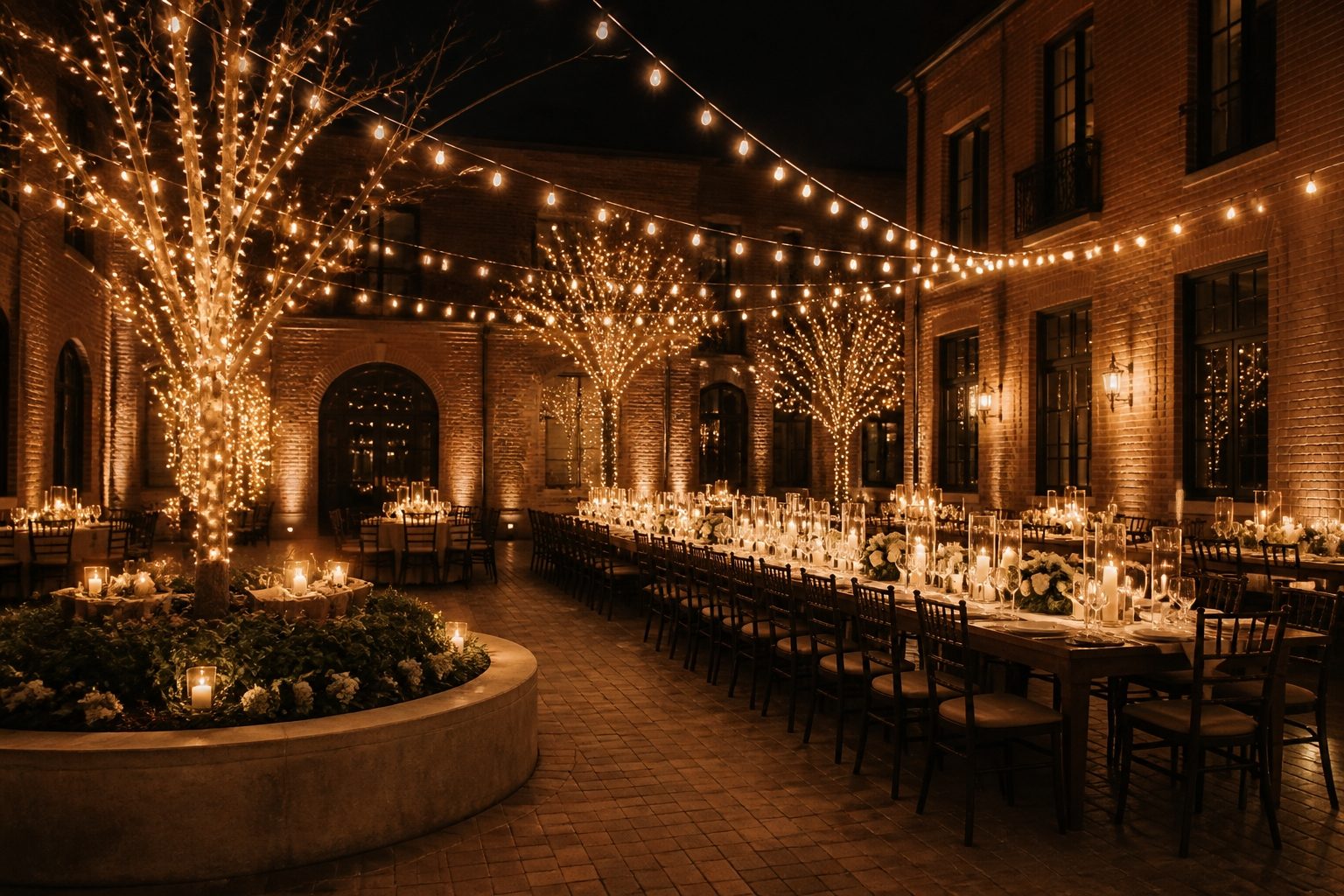



Home/Holiday & Event Lighting
Year-round · Boston
Holiday & Event Lighting in Boston
Christmas is one night in twelve months. The rest of the year has Hanukkah, Halloween, July 4th, weddings, corporate parties and store openings — and each one has a different lighting problem.


Local guide · Holidays & events
Permits for events in Boston
For event lighting, the trigger is usually the footprint rather than the fixture: a private façade display is different from a queue, lift, cable run, generator, or rig that reaches a sidewalk, plaza, or street. Boston outdoor public-event permitting guidance requires a detailed site plan and proof that the event space is approved.
| FOOTPRINT | PERMIT | ISSUING BODY |
|---|---|---|
| City park event | Park Reservation permit | Parks Department |
| City Hall Plaza or Faneuil Hall | Public Event permit | Consumer Affairs and Licensing |
| Street or sidewalk restriction | Street Occupancy Permit | Public Works |
- Plan as one site package: We supply fixture locations, rigging points, power load, dimensions, and install-and-strike times for the applicant’s event package.
- Keep public access clear: A sidewalk obstruction requires an ADA-compliant pedestrian detour.
- Allow lead time: Street Occupancy Permit applications are due at least seven business days before public space is needed.
Reserving Parks, Plazas and Public Buildings in Boston
Public ground is bookable, but a reservation grants permission to use the site, not automatic approval for every tent, power source, or installation method. Events in City parks need a Park Reservation permit, while City Hall Plaza, Faneuil Hall, Sam Adams Park, and the area outside the Civic Pavilion use the Public Event permit process.
- Start with the ground: Secure venue approval before plotting strings, uplights, staging, or generator placement.
- Separate approvals: The event organizer coordinates the site plan; temporary structures and electrical work may require separate review.
- Protect the surface: Build ground protection, ballast locations, cable routes, and strike access into the plan before equipment arrives.
- Private commercial sites: A commercial-property event requires a permission letter or rental agreement from the owner or manager.
Fire Marshal Requirements for Tents, Stages and Temporary Structures
A tent, covered stage, or temporary platform must be planned as a short-life structure with controlled access, stable anchoring, protected egress, and a clear strike plan. The City’s outdoor public-event application guidance calls for a detailed site plan, making structural locations and emergency paths part of the lighting layout from the beginning.
| STRUCTURE | PLAN FOR |
|---|---|
| Tent or canopy | Fabric documentation, anchoring, exits, and clear access around the structure |
| Stage or riser | Stable deck, protected edges, egress routes, and cable-free walking paths |
| Heater or generator area | Fuel handling, equipment separation, and a route that does not cross guest circulation |
- Rigging first: Decorative lighting attaches only to approved points, never as a substitute for structural support.
- Wind changes the plan: Ballast, fabric, suspended décor, and exposed uplights should be reviewed together before load-in.
- Preserve exits: Keep exits, service access, and emergency lanes free of cable ramps, cases, and lighting stands.
Street Closures, Noise and Light Curfews in Boston
One evening can run on three separate clocks: the approved street or sidewalk occupancy period, the event’s operating schedule, and the time needed to install and remove equipment. A Boston Street Occupancy Permit is required when work temporarily restricts access to a street or sidewalk.
- Build the traffic plan early: Public Works requires the work scope, duration, traffic plan, and Boston Police detail plan with an occupancy application.
- Account for the full footprint: A kerbside generator, lift, queue rail, and cable crossing can affect the public way even when the event itself is on private property.
- Reduce light spill: Aim fixtures down, shield visible sources, avoid direct glare into homes and upper-floor windows, and switch decorative lighting off after the event.
- Budget public-space use: The permit has a base fee, space charge, and surety-bond requirement described in the City’s occupancy rules.
1 City Hall Square, Room 714
Boston, MA 02201-2024
Phone: 617-635-4900
Official Website
Public Works - Permitting
1 City Hall Square, Room 715
Boston, MA 02201
Phone: 617-635-4911
Official Website
Temporary Power and Generator Permits for Outdoor Events
Temporary power is often the quiet detail that determines whether an event can open on time: loads must be calculated, circuits assigned, and cable paths settled before décor is installed. The Massachusetts Electrical Code is based on the 2026 edition of NFPA 70 and took effect on April 24, 2026.
- Calculate, do not guess: Add lighting, catering, sound, charging, and any weather-sensitive equipment before selecting a generator or existing circuit.
- Use the right electrical process: New or altered wiring requires an Electrical Permit, and only a licensed contractor may apply under Boston electrical permit requirements and fees.
- Manage cables as a safety item: Keep conductors out of guest paths where possible and protect unavoidable crossings from foot traffic and moisture.
- Plan for weather: Outdoor connections and equipment need suitable protection for the event conditions, not improvised coverings after rain begins.
Neighborhoods we serve in Boston
Event lighting logistics change block by block, from dense historic streets to waterfront commercial settings and larger outer-neighborhood properties.
- Back Bay: Brownstone façades, busy sidewalks, and formal event entrances call for compact staging and carefully aimed architectural lighting.
- Beacon Hill: Historic streets and visible exterior changes demand discreet attachment methods and early review of façade conditions.
- South End: Restaurant corridors and townhouse blocks benefit from low-glare party lighting that respects pedestrian traffic and neighboring windows.
- North End: Narrow streets and active dining frontage make delivery timing, compact equipment, and cable routing central to the install plan.
- Wharf District: Waterfront event settings need wind-aware fixture placement, secure ballast, and an orderly path from load-in to strike.
- Fenway-Kenmore: Corporate gatherings and photo shoots often require flexible setup windows around dense pedestrian movement and venue access.
- Charlestown: Residential celebrations and community events benefit from contained lighting layouts that preserve clear approach routes.
- Hyde Park: Its more suburban setting can offer broader private-site layouts for tents, driveway access, and controlled temporary power placement.
Plan ahead
Tell us the date and the space.
We will tell you what is possible, what it costs and how long it takes to strike. Most event quotes go out within two business days.