
Home/Permanent Lights
Install once · Boston
Permanent Outdoor Lighting in Boston
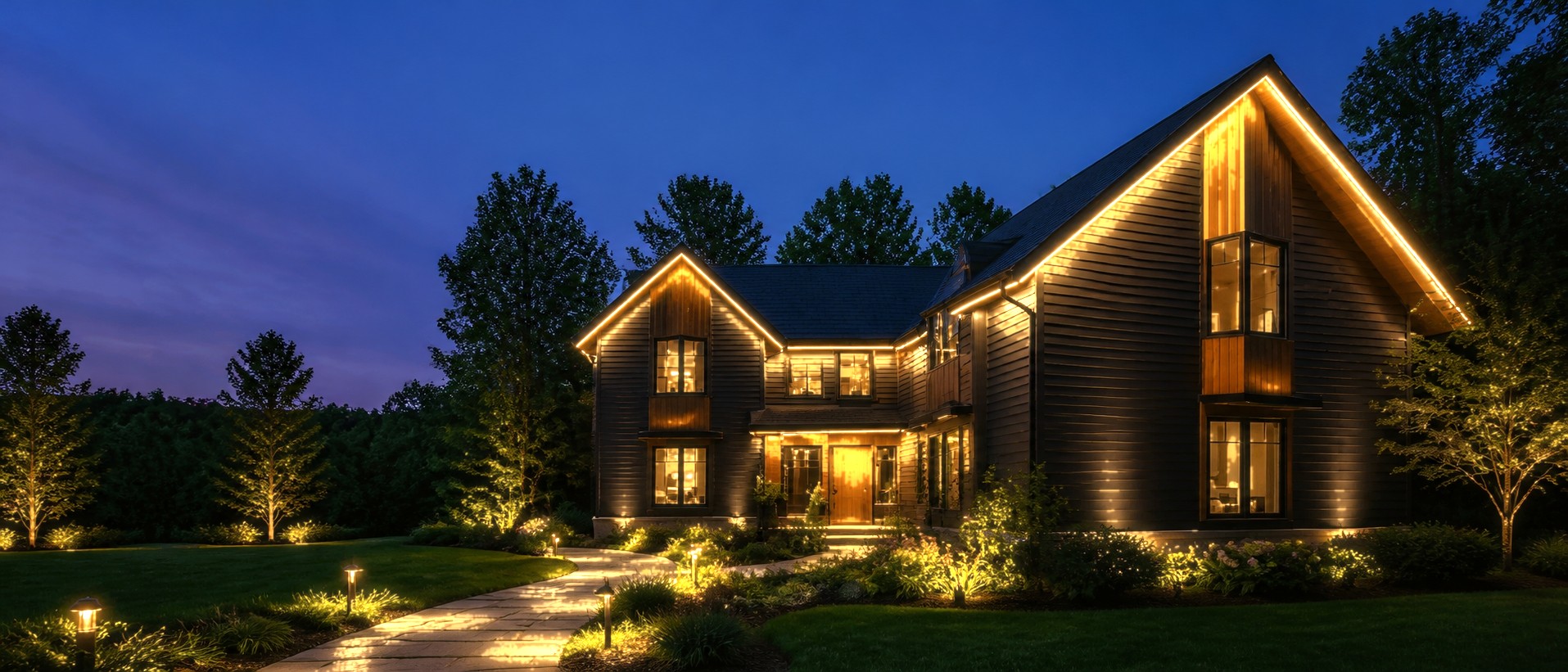
A slim, hidden LED track under the eave, controlled from your phone. Christmas, Halloween, July 4th, a game night — same hardware, different colour, no ladder, no storage, no January takedown.


Local guide · Permanent lighting
Permanent lighting and electrical code in Boston
A permanent LED system is attached to the building and connected to its electrical system, so it is a small construction project rather than seasonal decoration. The Massachusetts electrical code effective April 2026 is 527 CMR 12.00, based on the 2026 edition of NFPA 70 with Commonwealth amendments; a specification written for an older edition is already behind.
- Plug-in versus fixed: A plug-in low-voltage set can be removable, while an architectural channel with a controller is normally hardwired even when the LEDs operate at low voltage.
- Building attachment: Channels must be planned around soffits, masonry, trim, drainage paths, and access for future driver replacement.
- Paper trail: Unpermitted hardwiring can become the owner’s issue during resale, insurance questions, or later electrical work.
- Boston conditions: Snow, wind-driven rain, narrow side yards, and close neighboring façades make concealed wiring and protected connections especially important.
Electrical Permits and Inspections for Permanent Fixtures in Boston
The electrical permit is filed by the licensed contractor performing the work, not by the property owner, which sets the project sequence from design through inspection. Boston electrical permit requirements and fees require the permit before work begins, require work to start within six months unless an eligible extension is granted, and require the licensed contractor to be onsite for inspection.
| SCOPE | PERMIT FEE |
|---|---|
| No service change | $20 application fee, plus $1 per fixture, plug, or outlet and $5 per approved meter |
| Service upgrade or new service | $20 application fee plus an amp-based charge |
| Inspection | Licensed contractor onsite |
- Historic façades: A fixed channel visible from a public way may be an exterior alteration in a landmarked property or local historic district; Boston historic district design review runs alongside electrical permitting, with attention to attachment method and reversibility.
- Access planning: If a lift, fencing, or staging restricts a sidewalk or street, follow Boston Street Occupancy Permit requirements, including pedestrian-access planning.
1 City Hall Square, Room 714
Boston, MA 02201-2024
Phone: 617-635-4900
Official Website
Public Works - Permitting
1 City Hall Square, Room 715
Boston, MA 02201
Phone: 617-635-4911
Official Website
Dedicated Circuits, GFCI and the Massachusetts Electrical Code
Most permanent-lighting problems begin at the circuit, not at the diodes: an overloaded run, unsuitable connection point, or poorly placed driver can create failures that look like a lighting defect. The current Massachusetts Electrical Code took effect April 24, 2026 and provides the compliance framework for the electrician’s installation decisions.
- Circuit planning: Size the circuit for the connected continuous lighting load and leave room for the controller and driver equipment.
- Long rooflines: Voltage drop on extended low-voltage runs can make distant sections dim or unstable, so feed locations and driver placement need to be designed before channel installation.
- Outdoor protection: Exterior receptacles, weather exposure, wet-location luminaires, fittings, and connection enclosures require the protection and ratings appropriate to their location.
- First inspection point: Grounding and bonding are checked before decorative effects, app pairing, or programmed scenes.
- Serviceability: Keep drivers and controllers accessible without removing large sections of finished trim or channel.
Utility Interconnection, Net Metering and Rebate
Permanent lighting is a load: it consumes electricity and does not generate it. Interconnection and net metering matter only when the same property has solar, and they belong to the solar system rather than the lighting installation; the lighting electrician instead evaluates load and whether a service upgrade is needed.
| ITEM | WHAT IT MEANS FOR LIGHTING |
|---|---|
| Interconnection | Not an application for a lighting load |
| Net metering | Relevant to onsite generation, not LED consumption |
| Commercial incentives | May apply to qualifying exterior fixtures with integral controls |
| Energy code context | Boston has adopted the Specialized Energy Code |
- Commercial controls: Massachusetts commercial lighting and controls incentives include select exterior LED fixtures with integral controls at commercially metered sites in participating sponsor territories.
- Eligibility details: The instant-lighting pathway limits eligibility to qualifying products with integrated occupancy, dual-sensing, or LLLC sensors, subject to stated exceptions, and equipment must be installed within 30 days.
- Building context: Boston Specialized Energy Code adoption supports careful fixture and control selection for larger commercial projects.
- Honest expectation: Incentives can support eligible controls and equipment but do not pay for a permanent-lighting installation.
Neighborhoods we serve in Boston
Permanent channels are planned around the character of each façade, from compact historic rowhouses to wider outer-neighborhood rooflines. Site access, visible mounting, electrical-panel capacity, and winter exposure shape the final layout.
- Beacon Hill: Historic masonry façades and highly visible eaves call for discreet channel placement and early review of exterior changes.
- Bay Village: Brick rowhouses often have tight access and short but prominent rooflines, favoring precise measurements and compact driver locations.
- Back Bay: Tall townhouses and commercial-residential buildings may require careful lift planning, protected sidewalk access, and long-run voltage management.
- South End: Repetitive rowhouse cornices benefit from straight channel alignment while preserving drainage paths and ornamental exterior details.
- Charlestown: Mixed historic homes and hillside streets make ladder positioning, roof-edge access, and controller placement part of the early survey.
- Dorchester: Varied housing types allow layouts ranging from small entry elevations to longer detached-home soffits.
- Hyde Park: The more suburban setting often provides broader side-yard access and longer roofline opportunities for segmented lighting zones.
- West Roxbury: Detached homes and deeper eaves can accommodate concealed channels, provided drivers remain reachable for future service.
Permanent lighting
Measure your roofline. That is the whole quote.
Send the length of the run and a photo of the soffit. We will come back with a fixed price, a power plan and an install date.